
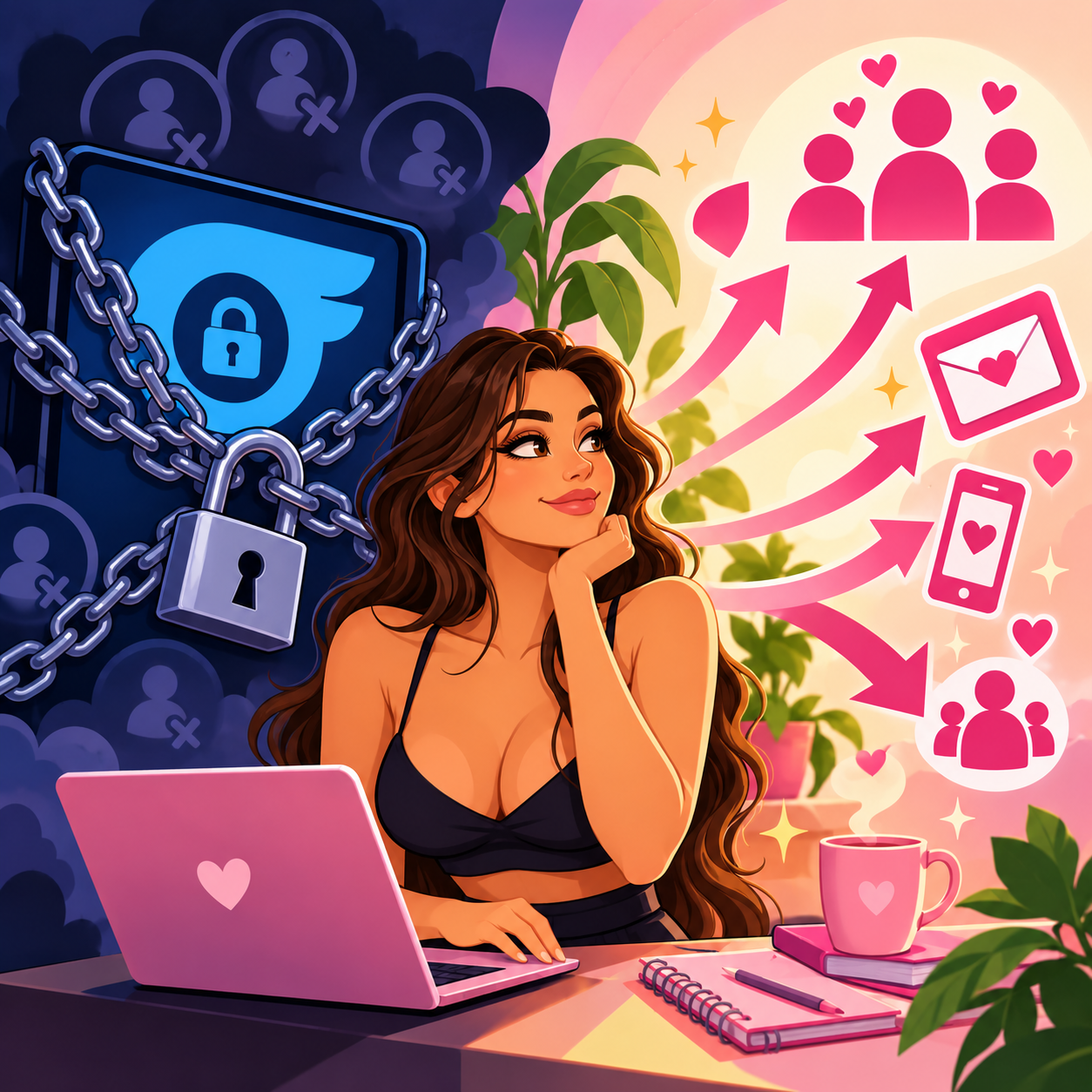
Every creator eventually learns the same hard lesson, usually at the worst possible time: the platform you built your audience on does not belong to you. Instagram can shadowban your account the morning of your biggest promo. TikTok can suspend you with no explanation and no appeal that actually works. Twitter/X can suspend your page for a policy violation you didn’t know existed. And OnlyFans itself, while generally stable, has shown creators in the past that platform-level rules can shift overnight.
When that happens, creators who spent months or years building a following on rented land discover they have nothing left. The followers, the likes, the DMs, the algorithm’s goodwill — none of it was ever truly theirs. It belonged to the platform, and the platform can take it back at any time, for any reason, with little warning.
This is the core problem this article is going to solve: the difference between renting an audience and owning one — and why every serious OnlyFans creator needs to make the shift from one to the other before a crisis forces the issue.
What “Renting” Your Audience Actually Means
When you build your following exclusively on social platforms — Instagram, TikTok, Twitter/X, Reddit, Snapchat — you are, in effect, a tenant. You’ve built a storefront on land owned by someone else, under rules that someone else writes and can rewrite at any time, with zero input from you.
Consider what you don’t control on a rented platform:
- The algorithm. One day your content reaches 50,000 people. The next, a silent algorithm change drops that number to 2,000, and you’ll likely never get a clear explanation why.
- The rules. Terms of service for mainstream platforms change regularly, and adult-adjacent content is almost always the first thing tightened when platforms want to “clean up” their image for advertisers.
- Your account’s existence. Bans, shadowbans, and suspensions happen to creators who’ve done nothing wrong, due to automated moderation systems that flag content incorrectly and offer limited recourse.
- Who sees your content at all. Even without a ban, “reach” is something platforms sell back to you through promoted posts. Organic reach for creator content has been declining across nearly every major platform for years.
None of this is a conspiracy. It’s simply how ad-supported platforms are built: their job is to keep users on their app, showing them content the algorithm thinks will keep them scrolling — not to guarantee you, specifically, a stable source of income.
Renting your audience means every dollar you earn is downstream of decisions you don’t make, enforced by rules you don’t write, on infrastructure you don’t own.
What “Owning” Your Audience Actually Means
Owning your audience means you have a direct line to your fans that does not depend on any platform’s algorithm, policy, or goodwill. If you own your audience, you can reach every single one of your fans tomorrow morning, regardless of what Instagram, TikTok, or Twitter decide to do with your account tonight.
The clearest markers of audience ownership are:
- An email list you can message any time, with no algorithm deciding who sees it
- A phone/SMS list you can text directly
- A Telegram or Discord community you administrate and control
- A personal website or bio page that doesn’t live or die by another platform’s rules
The distinction matters because of a simple truth in direct-response marketing, often summarized as: “The money is in the list.” Social media followers are an audience you’re borrowing. An email list, SMS list, or Telegram community is an audience you keep.

Why This Matters More for OnlyFans Creators Specifically
Every creator benefits from owning their audience, but for OnlyFans creators, the stakes are higher for a few specific reasons.
1. Your top-of-funnel platforms are the ones most likely to restrict you
Most OnlyFans creators build awareness using platforms that are, by nature, uncomfortable hosting adult-adjacent promotion: Instagram, TikTok, Twitter/X, Reddit. These platforms tolerate suggestive content up to a point, and that point moves constantly. A creator whose entire funnel depends on Instagram traffic is building a business on a foundation that platform could legally and contractually pull out from under them tomorrow, with no warning and limited appeal process.
2. Payment processors add a second layer of platform risk
Adult creator platforms occasionally face pressure from banking partners, payment processors, or app stores — pressure that can trigger sudden policy shifts across the entire industry, not just one account. A creator with no owned audience has no way to notify fans or redirect them if a platform-level shift happens.
3. Subscriber churn is brutal without a reactivation channel
OnlyFans subscriptions lapse constantly — fans forget to renew, get busy, or simply drift. Without an owned channel (email, SMS, Telegram) to win them back, that revenue is gone for good. With one, a simple “I miss you” message or a return-offer campaign can recover a meaningful share of lapsed subscribers — something no social platform will reliably deliver for you, because re-engagement campaigns are not what their algorithms are optimized to promote.
4. Price and promo control
When you own your list, you control when a promo goes out, who sees it, and how often. When you’re relying purely on organic social reach, your “marketing calendar” is actually dictated by whatever the algorithm decides to show that day.
The Creator Funnel: Rented Awareness, Owned Relationship
The goal isn’t to abandon social media — that’s unrealistic and unnecessary. Social platforms are genuinely excellent at the thing they’re good at: discovery. They’re how strangers find you in the first place. The mistake is stopping there and never converting that stranger into someone you can reach directly.
A healthy creator funnel looks like this:
- Discovery (rented): TikTok, Instagram Reels, Twitter/X, Reddit — platforms built for reach and virality
- Capture (the critical step most creators skip): A link-in-bio page, lead magnet, or free offer that gets a fan onto your email list, SMS list, or Telegram
- Ownership (yours forever): Email, SMS, Telegram, or Discord — channels you control completely
- Monetization: OnlyFans, direct sales, or any other paid offer you promote through your owned channels
Most creators build steps 1 and 4 and skip steps 2 and 3 entirely. They post content, hope it converts directly into OnlyFans subscribers, and never capture a durable relationship with the fan who clicked. That fan either subscribes and eventually churns with no way to be brought back, or doesn’t subscribe at all and disappears forever.
The fix is deceptively simple: capture the fan’s contact information before asking for the sale.
Building Block #1: The Email List
Email is the oldest “owned” channel on the internet, and it remains one of the most underused tools among OnlyFans creators — largely because it feels old-fashioned compared to Telegram or Snapchat. That reputation is undeserved. Email has a few structural advantages nothing else fully replicates:
- It almost never disappears. Email providers don’t ban users for subject matter the way social platforms do, as long as you’re not spamming.
- It’s portable. You can export your list and move it to a different provider any time. Try exporting your Instagram followers — you can’t.
- It has no algorithm. If someone’s on your list and your email doesn’t bounce, it lands in their inbox (or at worst, their promotions folder). That’s a dramatically higher guaranteed reach than any social post.
- It supports segmentation. You can message your biggest spenders differently than brand-new fans, something nearly impossible to do on social platforms.
How to start building an email list as a creator
Offer something in exchange for the email address. Fans won’t hand over their email for nothing — give them a reason:
- A free preview set or short clip
- A discount code for their first month
- Entry into a giveaway
- Early access to a drop or promo
Put the signup link everywhere. Bio links, post captions, video descriptions, pinned tweets/posts — the offer should be unavoidable for anyone who finds you.
Email consistently, not just during promos. A list that only hears from you when you want something feels transactional and unsubscribes faster. Mix in personality, behind-the-scenes content, and genuine updates with your promotional sends.
Segment by engagement and spend. Not every fan deserves the same message. Your top spenders should get VIP treatment; cold subscribers who haven’t opened an email in months need a different re-engagement approach entirely.
Building Block #2: SMS / Text Clubs
If email is the dependable workhorse, SMS is the high-urgency sibling. Open rates for text messages dramatically outperform email — most texts get read within minutes of being sent, which makes SMS the single best channel for time-sensitive promos, content drops, or flash sales.
The tradeoff is that SMS is more intrusive, so it needs to be used more sparingly and with explicit opt-in consent. A fan who gave you their email expects occasional emails. A fan who gave you their phone number is making a much higher-trust commitment, and that trust needs to be protected by not overusing the channel.
Best practices for SMS lists:
- Get explicit opt-in — never add anyone to a text list without clear consent
- Reserve texts for genuinely time-sensitive content: live drops, flash sales, “online now” alerts
- Keep frequency low — once or twice a week is usually the ceiling before fans start opting out
- Always make opting out easy and honor it immediately
Building Block #3: Telegram and Discord Communities
Telegram in particular has become a default home base for many adult creators, and for good reason: it allows large broadcast channels, supports media sharing without the moderation friction of mainstream platforms, and gives creators a direct line to fans that functions almost like a hybrid of email and social media.
What Telegram does well:
- Broadcast channels reach every member without algorithmic filtering
- Media-rich content (photos, videos, voice messages) is easy to share
- Community features let superfans interact with each other, deepening loyalty
- It’s relatively resilient to the kind of adult-content moderation crackdowns that hit Instagram and TikTok
What to watch out for:
- Telegram is still a platform you don’t own — a channel ban, while less common, is still possible
- It shouldn’t be your only owned channel; treat it as one leg of a multi-channel strategy, not the whole stool
Discord works similarly and is worth considering if your audience skews toward community-driven engagement rather than one-way broadcast content.
Building Block #4: A Personal Website or Bio Page
A personal website — even a simple one — is the closest thing to true digital real estate a creator can have. Unlike a social profile, a website is hosted on infrastructure you control (or at minimum, pay directly for), and it can’t be suspended by a platform’s trust and safety team because it isn’t a platform account at all.
A strong creator website or bio hub typically includes:
- Links to every active platform (OnlyFans, social accounts, Telegram)
- An email signup form front and center
- A content preview or free sample to build trust before the ask
- Clear, simple navigation — fans decide in seconds whether to stay or leave
Even a single, well-designed bio page that captures emails before sending traffic onward is a major upgrade over a raw “link in bio” that sends cold traffic straight to a paywall with no capture step at all.
The Real Cost of Not Owning Your Audience
It’s worth being blunt about what’s actually at stake. Consider two creators with identical OnlyFans income today.
Creator A has built her following entirely on Instagram and TikTok. She has no email list, no SMS list, and no Telegram channel. Her entire business depends on two apps she doesn’t control.
Creator B has the same following size, but has spent six months capturing emails and building a Telegram channel alongside her social growth. She has 4,000 email subscribers and a 1,500-member Telegram channel.
If Instagram restricts Creator A’s account tomorrow — even temporarily — her discovery funnel goes to zero. She has no way to tell her existing fans what happened, no way to redirect them, and no way to keep selling to the audience she spent months building. Her income doesn’t just slow down; it can fall off a cliff overnight, with no graceful way to recover.
If the same thing happens to Creator B, she loses a discovery channel — which hurts — but she can immediately email and message her entire list explaining the situation, redirecting them to her OnlyFans, her new primary platform, or wherever she needs them to go. Her business takes a hit, but it survives, because the relationship with her fans never depended on Instagram’s goodwill in the first place.
This is the entire argument for audience ownership in one comparison. Platforms are acquisition channels. Owned audiences are the business itself.

A Practical 30-Day Plan to Start Owning Your Audience
If this all sounds like a lot to build at once, here’s a simplified path to get the foundation in place within a month.
Week 1: Set up the infrastructure
Create an email marketing account (even a free tier works to start), set up a simple bio page with a signup form, and create a Telegram channel if you don’t already have one.
Week 2: Build your first lead magnet
Decide what you’ll offer in exchange for an email or phone number — a free clip, a discount, a giveaway entry — and get it ready to deliver automatically.
Week 3: Update every bio and link
Replace raw OnlyFans links in your social bios with a link to your capture page instead. Every piece of new content should funnel toward the capture step before the sale.
Week 4: Send your first real campaign
Email your new list with something other than a hard sell — introduce yourself, share a bit of personality, and remind them why they signed up. Then follow with a soft promotional send a few days later to see how the list responds.
From there, the habit is simple: every piece of content you post publicly should have a path that leads interested fans toward an owned channel, not just toward a one-time sale.
Common Mistakes Creators Make With Owned Audiences
Only emailing when there’s a promo. Fans unsubscribe fast from lists that feel purely transactional. Mix value and personality into your sends, not just sales pitches.
Never segmenting the list. Treating a brand-new subscriber the same as a two-year superfan wastes the data you’ve worked hard to collect. Segment by spend, engagement, or signup date at minimum.
Building the list too late. The best time to start an email list was when you posted your first piece of content. The second-best time is today — don’t wait for a platform crisis to force the issue.
Treating Telegram as a replacement for email rather than a complement. Telegram is powerful, but it’s still a third-party platform. The strongest creators run both.
Neglecting list hygiene. An email list full of cold, unengaged addresses hurts deliverability over time. Regularly clean out inactive subscribers and re-engage them with a win-back sequence before removing them.
Conclusion: Stop Building on Land You Don’t Own
The creators who build the most durable businesses aren’t necessarily the ones with the biggest follower counts — they’re the ones who understand the difference between an audience that’s lent to them by an algorithm and an audience they can reach directly, on their own terms, any day of the year.
Social platforms will always be part of the discovery process, and that’s fine. The problem isn’t using Instagram or TikTok to find new fans. The problem is stopping there, and never converting that borrowed attention into something you actually own.
Every email address, phone number, and Telegram member you capture is a small piece of insurance against a risk every creator eventually faces: waking up to find a platform has changed the rules, and there’s nothing you can do about it. Creators who’ve already built an owned audience barely notice when that happens. Creators who haven’t are often starting over from zero.
The sooner you start treating audience ownership as core infrastructure — not an optional extra — the more resilient your business becomes, no matter what any single platform decides to do next.